
2024: A year in review

Hello friends,

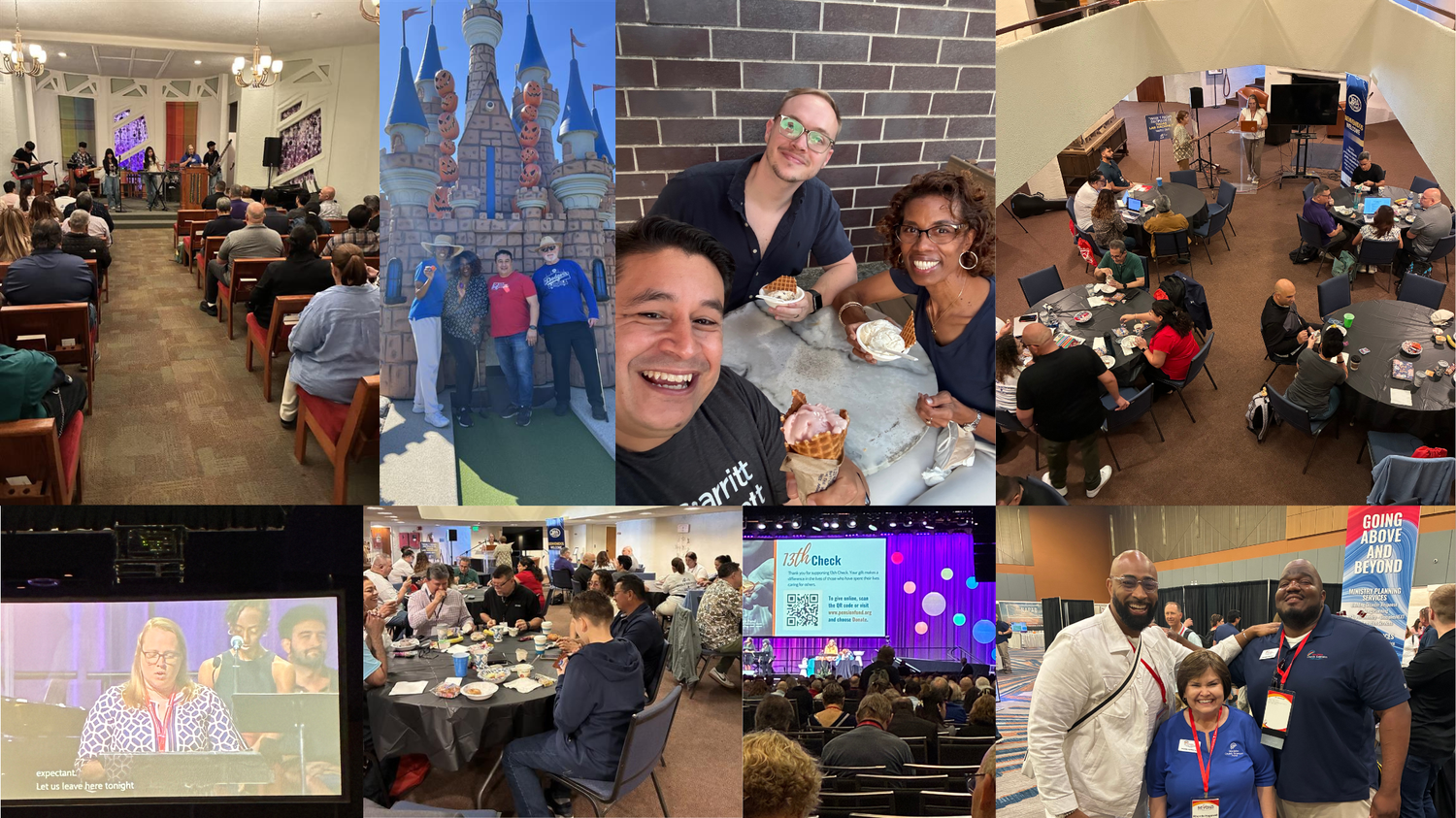
As you know, it is getting close to the end of the year. When you read this letter, you know change is happening around the States. You may have felt the angst that many Americans are feeling. The main question many Disciples are asking themselves is, “what should we do?” For New Church Ministry (NCM), our answer is how to empower our places of worship to be a sanctuary for their neighborhood. This past year, our motto has been “We are all New Church.” What we mean by this is that in this post-lockdown, war-torn, politically stratified world, our neighbors need a safe place to encounter the grace and love of God. In this year’s Leadership Academy, we saw how some emerging congregations are being a physical reminder of the Holy to their communities. Through our IMPACT webinar series, we are getting leaders to share their experiences to help us continue to think about how communities of faith can respond to these various challenges. Additionally, the team has been to over 30 events together, representing NCM. Our team has been there from Canada to Florida for gatherings, celebrations, and funerals.

Our church has gone through a lot this season, but in particular, our ministry suffered a loss with the passing of Reverend Dr. Franciso Ramos. NCM was able to participate in his celebration of life ceremony in the Pacific Southwest Region. Dr. Ramos was one of our most sought-after coaches within the Coaching Ministry. We will greatly miss him.

As we look to 2025, there are a few things that we are looking forward to. First and foremost, this is a General Assembly year. We are workshopping many ideas to see how we can give deep experience at GA 2025 in Memphis, TN. Additionally, we continue building our Coaching Ministry curriculum to become a member organization accredited by the International Coaching Federation. Lastly, we are looking to build on current partnerships and form new partnerships to create the best experience possible to Train, Equip, Assist, and Multiply emerging and affiliating leaders of the Christian Church (Disciples of Christ) in the United States and Canada. We cannot do this work without you, so we thank God for you, who support us in many ways.  

~ Rev. Dr. Jose Martinez, Minister of New Church Strategies

Chapelle Ste-Marthe: Deep Christian spirituality and a passion for God’s love and justice in Montréal

The current religious landscape of Québec, Canada is one of duality, dominated by the historic Roman Catholic Church and the growing secularism that got its start in the Quiet Revolution of the 1960s and 1970s. 

Before this binary dynamic took hold, indigenous faiths were practiced first by the Kanien’kha:ka, Haudenosaunee, Anishinabeg, and Algonquin peoples living in what we now call Québec. Over time, other religions arrived in the province, including Islam, Judaism, Buddhism, Hinduism, and Sikhism. However, the majority of Québecois today either identify as Christian or with no adherence to any religion at all.

Against this religious backdrop, a small, informal community of faith exists, one that serves young adults and students who are seeking a meaningful connection with God – and it’s right in the heart of Québec’s largest city, Montréal.

Chapelle Ste-Marthe (St. Martha’s Chapel) is an emerging place of worship, one that is marked by deep Christian spirituality and a passion for God’s love and justice, that you can support this year during the Pentecost Offering.

St. Martha’s Chapel has its origins in the ecumenical chaplaincy at McGill University and regularly hosts events in partnership with the institution, such as interfaith text studies or the annual Discover Spiritual McGill Fair.

“The chapel’s name was inspired by an earlier iteration of the ministry called ‘St. Martha of the Basement,’ highlighting the centrality of hospitality and inclusivity to the mission,” says Rev. Jean-Daniel Ó Donnċada, the former director and chaplain now serving as the Canada region’s national pastor.

It has been a shared ministry between the Anglican Church of Canada and the United Church of Canada for decades, with the Christian Church (Disciples of Christ) in Canada becoming a sponsor in 2015.

In 2020, the ministry changed its name from McGill Ecumenical Chaplaincy and evolved its direction to be a young adult-led organization open to working young adults and students attending other universities with most members being professionals in their 20s and 30s.

One such student turned professional is Sarah Wicks-Potter, who became the interim director and chaplain last summer. 

“I moved to Montréal when I was 18 for university. My aunt and uncle set me up on a friend date with the one person they knew in the city, and she invited me to Bible study. She brought me to St. Martha’s and I’ve been there about every week since,” she recalls. “I met my roommates, some of my best friends, my husband, and a couple whose son I’m now a godmother to at the chapel.”

In addition to providing pastoral care in both English and French (with help from Rev. Jean-Daniel for the French speakers), Sarah is now the one leading Bible study for her community of faith. This weekly event is open to adults ages 18 to 40 and provides time to engage in spiritual practices and share a meal. 

“It might be hard to see young people in the church without St. Martha’s,” she explains, “and you can really see that at Bible study.”

The chapel also provides evening worship services on the first and third Sundays of each month in cooperation with Cathédrale Christ Church (Christ Church Cathedral), which donates two rooms in its lower level for the ministry to use. St. Martha’s services are casual and are open to all who wish an evening time to pray. 

“Wherever you are on your journey with Jesus, whether you’re doubting or angry, the people at St. Martha’s are always there to accompany you, not convert you,” clarifies Sarah. “Even when you graduate and move away, that doesn’t change.”

Sometimes this support can be joyous, too. When a member was baptized in February, all the people from St. Martha’s showed up. In June, they plan to attend a play written by one of their members and be that “obnoxious group of young people in the audience.”

The community even provides more “logical support,” as Sarah puts it. Last fall, one of its members was recovering from surgery, so they put together a meal train. Whatever way this support looks like, it ultimately depends on what people need and how they need it. 

The chapel is also LGBTQ+ affirming and an incredibly vocal space for queer rights within Christianity. While Montréal is safe for the LGBQ+ community, not all churches in the city are.

“Part of my job is to figure out how to connect the puzzle pieces that keep our community strong,” Sarah finishes, “I like what I do a lot.”

To ensure that faith communities like St. Martha’s Chapel can continue to provide radically accepting places of worship in their neighbourhoods, make a gift to the 2024 Pentecost Offering. Received in most congregations on Sundays, May 12 and May 19, this Special Day Offering is equally divided between the region in which it’s collected to support local new church development and New Church Ministry, which trains, equips, assists, and multiplies emerging and affiliating leaders and their congregations. Thank you for your generous support.

WHOSOEVER: “God did not create you to hate you”

The Greater Kansas City region is the most compact regional ministry of the Christian Church (Disciples of Christ) in the United States and Canada.

There are open and affirming congregations as well as places of worship where most of the members are people of color (POC). But before 2017, if you were searching for a faith community of both, you would be hard-pressed to find one.

That was until Rev. Dr. Dionne T. Boyice created WHOSOEVER: Community of F.A.I.T.H. (Finding Answers in the HEALING), a Facebook group that provides a safe space for all LGBTQ+ people, especially POC, who want to worship God.

Today, Dionne and the 1,200+ members of WHOSOEVER: Community Of F.A.I.T.H. are active online, with those living in Kansas City, KS and MO gathering in person once a month to worship and provide outreach services. These efforts are made possible with the gifts made to the Pentecost Offering, which supports leaders and communities as the Spirit calls them into being.

Seven years ago, Dionne preached at the first Black PRIDE worship service in Kansas City, MO. Following her sermon, about 25 attendees inquired about her church, citing the lack of local congregations led by an LGBTQ+ POC. Back then, Dionne didn’t have a church nor was she a pastor. But after so many people approached her, she felt called to create a community of faith where Black LGBTQ+ folks, who were suffering from religious trauma, spiritual abuse, and/or moral injury, could praise God.

“I’ve been a Baptist for most of my life. In my experience, the Black church is so vocal when they describe homosexuality as ‘the work of the devil’ or a sin, that they push Black LGBTQ+ people out the door,” shares Dionne. “But these people are still searching for and desire a relationship with God.”

So, she created WHOSOEVER, taking inspiration for its name from the John 3:16 Bible verse “For God so loved the world, that God gave the only begotten Son, so that whosoever believes in Him will not perish, but have everlasting life.” For Dionne, there are no exceptions to the scripture the way it is written – we are all loved by Christ on the cross, whosoever we are.

“The word ‘whosoever’ means anybody, any person at all,” she explains. “If we teach scripture the way it was meant to be understood, then it’s a difficult argument to make that God sent the Son to be sacrificed for only a select group of people.”

Dionne does not describe WHOSOEVER as a “gay church” or a “Black church,” even though most of its members identify as such. She doesn’t want to exclude anyone who may not identify as LGBTQ+ or Black from attending, being a part of, or worshipping at WHOSOEVER.

“Believe it or not, many POC who are LGBTQ+ don’t want to be a part of an LGBTQ+ church because they were told they would go to hell if they did,” Dionne reveals. “The people who are comfortable in their own skin have no problem with coming right on in.”

In 2018, Dionne reached out to Greater Kansas City Regional Minister Rev. Bill Rose-Heim, who introduced her to National Convocation Administrative Secretary and Associate General Minister Rev. Dr. Delesslyn Kennebrew, the Regional Minister for New and Transforming Churches at the time. This connection saw Dionne be a part of the new church cohort for the next two years.

In the meantime, her congregation connected with other marginalized communities, as well as organizations like PFLAG. WHOSOEVER participated in Kansas City’s PRIDE celebrations and conducted worship services via Zoom. Members joined virtually from Canada, the United Kingdom, Liberia, and Kenya – in fact, most of WHOSOEVER’s virtual members are located outside of Kansas City.

“We are a global ministry,” Dionne points out, “because there are so many cultures that still teach an embedded theology learned hundreds of years ago. Unfortunately, they’re not open to a broader context or theology.”

In 2020, she became ordained through the United Church of Christ and moved out east to serve a congregation in Havertown, PA. Despite the distance, Dionne maintained her Kansas City roots and built partnerships with local Disciples, including Minister of New Church Strategies Rev. Dr. Jose Martinez. For PRIDE of that year, he featured Dionne and her wife on his podcast StoryWagen, where they discussed the challenges in finding healing from a church that continues to hurt so many.

“LGBTQ+ people are growing in their faith, rejecting what they’ve been taught about their identity, and are feeling more accepted,” she says. “They’re learning that they are valued by God, no matter who they are or what they’ve done.”

Dionne returned from Pennsylvania in 2022 and the people of WHOSOEVER began to worship together in person once a month. They have gathered at other churches, Dionne’s house, a woodshop, coffee shops, and, even, a grocery store. The following year, she became a Disciple and took part in New Church Ministry’s first-ever hybrid Leadership Academy, which provides educational opportunities for faith leaders, students, and ecumenical partners, no matter their church’s life stage.

Dionne also started taking the first steps in affiliating her congregation with the denomination. 

“I came up with ‘God Did Not Create You To Hate You’ as the tagline for WHOSOEVER because I myself used to associate the church’s practice of pushing us out, with what God wanted,” reflects Dionne. “When churches do that, people stay away from church. We must learn to disconnect the human institution from the body of Christ.”

Church members currently worship in person on the campus of the Kansas City Kansas Community College. In June, they will finally have their own space.

Outside of worship, the people of WHOSOEVER engage in community service. Once a month, they serve free hot soup to houseless neighbors, and they’ve even been able to assist others with their finances and rent.

As for the future and the well-being of LGBTQ+ POC, Dionne believes that the younger generation is “our saving grace.”

“They won’t attend churches that refuse to welcome their friends and family just because they are LGBTQ, or drink, or have children out of wedlock,” she concludes. “They are really trying to live out the answer to, ‘what would Jesus do?’”

To ensure that congregations such as WHOSOEVER can continue to provide its vital services to LGBTQ+ folks, POC, and other marginalized communities, participate in this year’s Pentecost Offering. Half of the gifts made on Sundays, May 12 and 19 stay in the region in which they’re collected to support local emerging and affiliating faith communities. The other half goes to New Church Ministry to support events like Leadership Academy, as well as coaching for new church leaders, educational webinars, and much more.

Celebrating Earth Day

There has never been a more important time for the church to be the church and live out the transforming love of Christ Jesus. Climate change is now impacting our local communities, congregations, and their ministries in a myriad of ways including financially, physically, emotionally, and spiritually. Yet, throughout the Bible, we are told that the earth is the Lord’s and therefore holy, and we are called to care for and learn from creation (Genesis 2.15, Ps. 24.1, Job 12.7-10), and to care for “the least of these among us” (Matthew 25) which includes the earth.

In these times, we need to remind ourselves and each other of the power and impact of the local church. Churches play an enormous role in supporting community needs, particularly for the most vulnerable. Close community connections mean that we know the critical needs of our communities and we respond. 

With the challenges of our times come incredible opportunities to be the church in new and innovative ways, living out the gospel in our local communities. New churches are called to find unique ways to care for the earth and all who depend on it as dictated by the location and context. Creation care, which is as ancient as our faith and important to many people’s spirituality, is a way for churches to be renewed and strengthened to each other, the local community, and God. 

Green Chalice is honored and blessed to partner with New Church Ministry to support and resource new churches to connect our faith, spiritual practices, and creation consciousness to demonstrate the fullness of God’s shalom. In honor of Earth Month, lead your church in becoming a Green Chalice Congregation!

~ Rev. Carol Devine, Co-Minister of Green Chalice

Rev. Carol Devine is the national faith and climate director for ecoAmerica’s Blessed Tomorrow program. She is an ordained minister in the Christian Church (Disciples of Christ) and founder of the denomination’s creation care ministry, Green Chalice. Carol served as a congregational pastor for 14 years in Kentucky where ecumenical and interfaith work was a priority. Before being called to ministry, Carol was a teacher and a Peace Corps Volunteer. She is a graduate of Transylvania University (BA), University of Kentucky (MS), and Lexington Theological Seminary (MDiv). She is the mother of three adult children and loves to travel, hike, kayak, cycle, garden, and read. 

A shortened version of this post also appeared in the April 2024 issue of the New Church Know-It-All.

Disciples church uses radical acceptance for drug misuse recovery, support for adults with intellectual disabilities

When you cross the Ambassador Bridge from Detroit, MI to Windsor, ON, you may think that you’re leaving behind the Motor City and entering a quaint Canadian town.

But as residents of Windsor know, that assumption couldn’t be farther from the truth.

While its American neighbor to the south garners more of the attention for its musical, architectural, and of course, industrial legacy, Windsor is a major contributor to Canada’s automotive industry and the site of the busiest Canada-U.S. border crossing. But like Detroit, Windsor has also experienced its fair share of economic decline. Residents have been hit hard by poverty and unemployment, which in turn has allowed the opioid crisis to flourish. 

It is in this hub that Freedom Church of Windsor is meeting the needs of residents struggling with addiction, as well as adults with intellectual disabilities. It’s also a testament to the power of church as a place of generosity and justice – one that you can support on Sundays, May 12 and May 19 by making a gift to the 2024 Pentecost Offering.

After a failed merger with another congregation, Rev. Jonathan P. Nantais re-started Freedom Church in January 2020 to provide a faith community that welcomed everybody to God’s table, from members of the LGBTQ+ community, to blended families, to folks with a myriad of religious backgrounds. In 2022, it affiliated with the Christian Church (Disciples of Christ) in Canada

Pastor Bradley Williams appears in the top left photo

“I’ve gone to a lot of different places of worship, but I never felt like I belonged until I came to Freedom Church,” recalls Student Senior Pastor Bradley Williams, who assumed leadership of Freedom Church with Minister of Administration Katie Burgos and Supervising Pastor Rev. Dr. Jen Garbin last summer after Rev. Jonathan answered a call to pastor a church in Houston, TX.

This theology of radical acceptance can be seen on Sunday mornings, whether it’s at Bible study, which folks can attend in-person or online, or afterwards at the worship services, where all are welcome to receive communion and children are encouraged to express themselves during worship.

Lisa Metivier appears in the bottom left photo

As for those struggling with drug misuse, the church helps them on their journey to sobriety by providing addiction resources, such as recovery meetings at the church and access to a clean-living house for clients to stay at who have detoxed and gone through a treatment program. With the high cost of living, the facility, which is managed by Pastor Brad, provides an opportunity for its inhabitants to both get off the streets and re-learn how to live clean again.

“My mother is a retired ordained minister, addictions counselor, and 45 years sober,” shares Lisa Metivier, who is the treasurer and interim vice-president of the church’s board.  “I grew up with my mom being very actively involved in Alcoholics Anonymous (AA). I’ve seen firsthand how these programs allow us to be there for our brothers and sisters facing active addiction.”

On Sunday mornings, a church van picks up the residents, as well as elderly members who can’t drive, for worship services. Church attendance isn’t mandatory for the clients – rather, Freedom Church wants to ensure that their community can find God if they need to.

“Many of our members struggle with addiction or are in recovery,” relays Pastor Brad. “At Freedom Church, we provide them with a safe atmosphere in which to learn about God and participate in the body of Christ without the judgment or stigma around addiction.”

In addition to the clean-living accommodations, folks can seek counseling from him during his office hours and/or attend Narcotics Anonymous or AA meetings held twice a week in the church building.

Freedom Church is always open for folks struggling with their addictions to drop in. The congregation did close their doors during the early days of the pandemic – until someone came to their building seeking help and overdosed. Since then, its doors have remained open.

Despite these many opportunities for support, the insidious nature of the opioid crisis leaves many people with substance abuse issues struggling with food insecurity as well. To address that, the congregation runs a food pantry and a community meal program. The latter takes place periodically throughout the month, when Freedom Church invites its neighbors in to eat breakfast or dinner and engage in conversation with their fellow diners. On Good Friday, its members broke bread and fried fish.

God’s presence also imbues itself into the church’s Freedom Respite Program, which provides art and music therapy, exercise classes, community outings, and more to adults with intellectual disabilities. Initially opened as a subsidiary of the church in 2022, the program is now a non-profit organization with its own roster of clients. From Monday to Friday, 7:30 AM to 4:00 PM, it provides daily programming to relieve parents or guardians who are not able to care for their families during the day due to work or other professional commitments. Freedom Respite currently has eight clients, all of whom are 21+, the age at which clients “age out” of the school system.

“Our church is about hope,” explains Lisa, who joined Freedom Church in 2019. “When we help people with food or transportation, these are the actions that we are taking to show them that God loves them.”

And these actions are practical, too. Windsor has an average temperature of -3 degrees Celsius (27 degrees Fahrenheit) during the winter season, so offering folks shelter and transportation gets them out of the cold.

“A lot of our members have come to our church to rebuild a faith they felt they weren’t worthy of having,” concludes Lisa. “So, every week we make sure to remind everyone that God wants everyone at the table. No one will be excluded.”

To ensure that communities of faith like Freedom Church of Windsor can continue to serve their communities, participate in this year’s Pentecost Offering. Half of the gifts made to this Special Day Offering stay in the regional ministry in which they are collected to support local new church development. The other half goes to New Church Ministry, which trains, equips, assists, and multiplies emerging and affiliating congregations and their leaders across the Christian Church (Disciples of Christ) in the United States and Canada.